
Bleeding and Clotting Disorders
Bleeding and Clotting Disorders
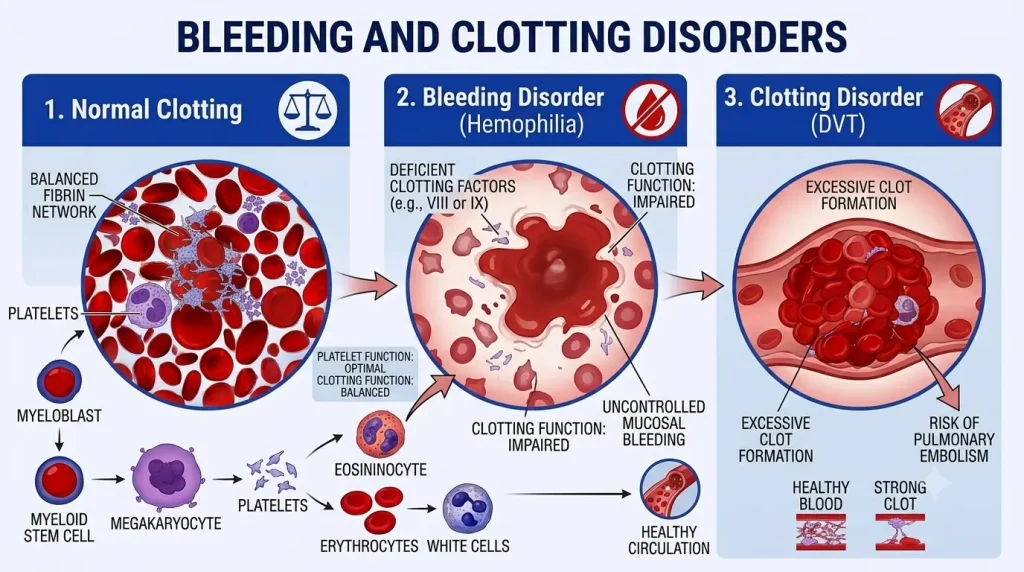
Bleeding and clotting disorders (coagulation disorders) occur when the body’s natural blood-clotting process, known as hemostasis, becomes unbalanced. Under normal conditions, proteins called clotting factors work alongside platelets to form a stable blood clot and prevent excessive blood loss when a blood vessel is damaged.
When this system fails, it leads to one of two extremes: bleeding disorders (where the blood cannot clot properly, causing excessive bleeding) or thrombotic disorders (where abnormal blood clots form inside blood vessels, obstructing blood flow to vital organs).
What the Conditions Are
Coagulation disorders fall into two major clinical categories:
Bleeding Disorders (Hypocoagulable States): Conditions where blood clotting is delayed or absent. Examples include Hemophilia A and B (deficiency of Factor VIII or IX), von Willebrand Disease (vWD) (deficiency or defect in von Willebrand factor), and severe liver disease-associated coagulopathy.
Clotting Disorders (Thrombophilia / Hypercoagulable States): Conditions where the body forms blood clots too easily or inappropriately within veins and arteries. Examples include Deep Vein Thrombosis (DVT), Pulmonary Embolism (PE), Antiphospholipid Syndrome (APS), Factor V Leiden Mutation, and Protein C or S Deficiency.
Common Symptoms
Symptoms depend on whether the underlying issue is excessive bleeding or abnormal clot formation:
| Category | Associated Symptoms |
|---|---|
|
Bleeding Manifestations |
Unexplained or spontaneous bruising, prolonged bleeding from minor cuts, frequent deep nosebleeds, bleeding into joints (hemarthrosis) causing swelling and severe pain, abnormally heavy menstrual bleeding, and prolonged bleeding following dental or surgical procedures. |
|
Clotting (Thrombotic) Manifestations |
Unilateral leg swelling, pain, warmth, or redness (indicative of DVT); sudden shortness of breath, sharp chest pain when breathing in, rapid heart rate, or coughing up blood (indicative of Pulmonary Embolism). |
Possible Causes & Risk Factors
Hemostatic imbalance can stem from genetic inheritance or acquired medical conditions:
- Inherited Genetic Mutations: Mutations in clotting factor genes (Hemophilia A/B, Factor V Leiden, Prothrombin gene mutation) passed down through families.
- Autoimmune Diseases: Conditions like Lupus or Antiphospholipid Syndrome, where autoantibodies interfere with clotting proteins or blood vessel linings.
- Acquired Factor Deficiencies: Severe Vitamin K deficiency, advanced liver disease (which impairs clotting factor synthesis), or severe systemic infections (causing Disseminated Intravascular Coagulation / DIC).
- Pro-Thrombotic Risk Factors: Prolonged immobility, major orthopedic surgery, active cancer, oral contraceptive/estrogen therapy, pregnancy, or heavy smoking.
When to Consult a Hematologist
You should seek evaluation from a specialist if you experience:
- Spontaneous or recurrent bleeding with no clear injury.
- A personal or strong family history of unprovoked blood clots (DVT/PE) at a young age (under 50).
- Recurrent, unexplained miscarriages or pregnancy complications (often associated with Antiphospholipid Syndrome).
- Abnormal excessive bleeding during or after minor surgeries, tooth extractions, or childbirth.
- Abnormal coagulation screen results (e.g., prolonged PT or aPTT) discovered during routine preoperative blood work.
How Coagulation Disorders Are Diagnosed
A comprehensive hematologic evaluation determines precise factor levels and clotting activity:
- Routine Coagulation Screen: Measures Prothrombin Time (PT/INR) and Activated Partial Thromboplastin Time (aPTT) to evaluate intrinsic and extrinsic clotting pathways.
- Specific Clotting Factor Assays: Measures exact activity percentages of individual proteins (e.g., Factor VIII, Factor IX, Factor VII).
- von Willebrand Antigen & Activity Panels: Measures quantity and functional capacity of von Willebrand factor.
- Thrombophilia Panel: Screen for genetic and acquired clotting risks (Factor V Leiden, Prothrombin gene mutation, Antithrombin III, Protein C and S levels, Lupus Anticoagulant, and Anti-cardiolipin antibodies).
- Vascular Imaging: Doppler ultrasound to detect Deep Vein Thrombosis (DVT) or CT Pulmonary Angiogram (CTPA) to diagnose Pulmonary Embolism.
Available Treatment Approaches
Treatment aims to restore clotting balance, manage acute bleeding or clotting episodes, and prevent future complications:
For Bleeding Disorders:
- Factor Replacement Therapy: Infusion of recombinant or plasma-derived factor concentrates (e.g., Factor VIII or IX) to prevent or treat bleeding.
- Desmopressin (DDAVP): Stimulates the release of stored von Willebrand factor and Factor VIII in mild Hemophilia A or vWD.
- Antifibrinolytic Agents: Medications (such as Tranexamic Acid) to stop clots from breaking down, particularly useful for mucosal bleeding or minor dental procedures.
For Clotting Disorders:
- Anticoagulation Therapy: Blood thinners (e.g., Direct Oral Anticoagulants / DOACs, Heparin, Warfarin) to prevent new clots from forming and stop existing clots from enlarging.
- Thrombolytic Therapy: Emergency "clot-busting" medications reserved for life-threatening clots (e.g., massive pulmonary embolism).
- Mechanical Interventions: Compression stockings or Inferior Vena Cava (IVC) filters in high-risk patients who cannot safely take blood thinners.
FAQs
Are blood thinners safe to take long-term?
Yes, under direct medical supervision. While blood thinners reduce the risk of dangerous blood clots, they increase the risk of minor bleeding. Regular monitoring and dosage adjustments by a hematologist ensure safe, long-term protection.
Can women with bleeding disorders have safe pregnancies?
Yes. With proactive management, specialized monitoring, and tailored factor replacement plans before, during, and after labor, women with Hemophilia carrier status or von Willebrand Disease can safely deliver.
Is a blood clot always hereditary?
No. Many blood clots are triggered by temporary risk factors like long-distance travel, immobility, surgery, or medication. However, a hematologist can perform a thrombophilia screen to check if an underlying genetic tendency contributed to the clot.
Our Services
Get an Appointment
Schedule your expert consultation with Dr. Nitin Chaudhary today.